
Puzzle & logic Beginner guide
Loop Garden: close the first loop in five turns
Solve Loop Garden’s first board by following the empty ground around its four corners. Learn why a glowing join can still need turning and how par counts moves.
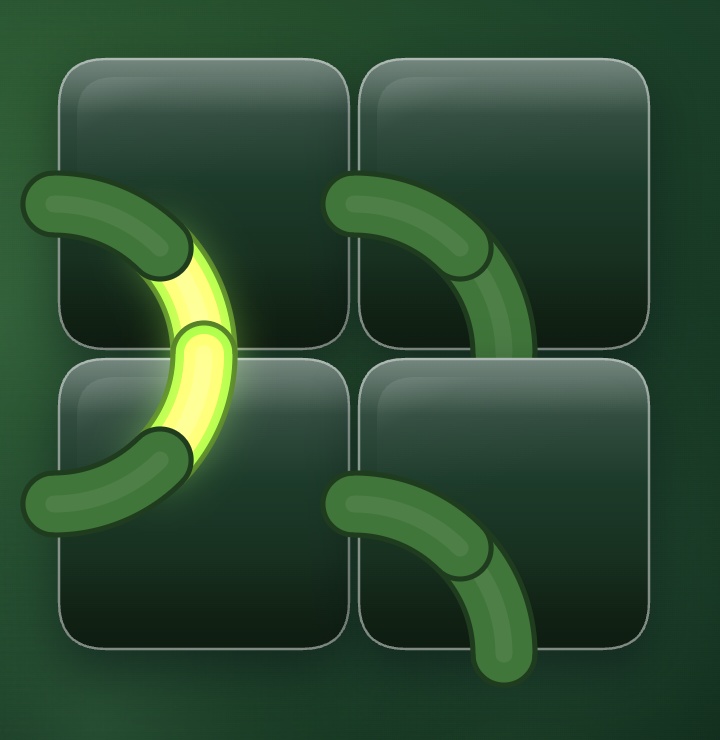
Start with the places a vine cannot go. In Loop Garden, our tile-rotation puzzle, every end must meet another vine, and all the pieces must form one closed loop. An end pointing into empty ground cannot stay there, even if the tile’s other end is glowing.
The first level makes that rule easy to see. Its four occupied tiles form a small square near the top-right of the board. The pictures here crop around those four tiles; the empty part of the board has not been filled in.
Turn the corners toward each other
Click or tap a tile to rotate it one quarter turn clockwise. You don’t drag pieces into new squares. On this first board, the empty ground around the four corners leaves each one only one useful orientation.
Starting from the board pictured above:
- Turn the top-left occupied tile three times. Its ends start pointing left and down. After three clockwise turns they point right and down, toward the two neighboring tiles.
- Leave the top-right tile alone. Its ends already point left and down, into the square.
- Turn the bottom-left tile once. Its ends change from up and left to up and right.
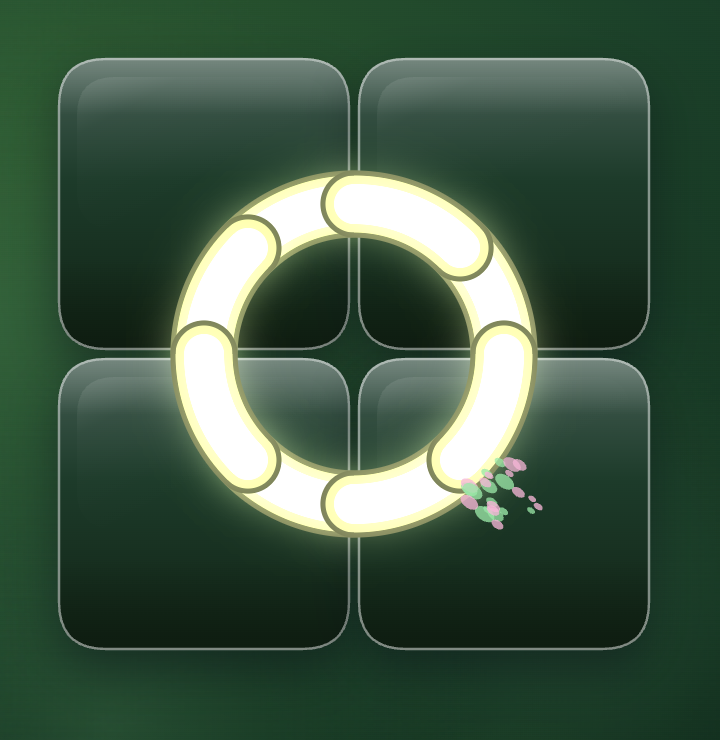
- Turn the bottom-right tile once. Its ends change from left and down to left and up, closing the loop.
That is five turns, matching the level’s Par 5. The garden blooms when the last corner joins:
Don’t protect a join just because it glows
In the starting picture, the two left tiles already share a bright connection. Keeping that connection unchanged would leave both tiles pointing into the empty space to their left.
The first turn breaks that glowing join. That’s fine. You’re making room for a complete loop, not trying to preserve every connection the scrambled board happens to have. Once both left corners face inward, they reconnect and their other ends join the right-hand tiles too.
On a larger board, use the same check: follow both ends of a tile. A bright connection tells you that two ends currently meet, not that the tile is settled. The finished garden needs every occupied tile in the same loop, rather than several separate loops.
Count clockwise turns, not tiles changed
Three tiles change in this example, but the top-left corner takes three separate turns. Par measures the fewest clockwise turns needed from the starting board. It isn’t a limit on how many tiles you may touch.
If you turn a piece too far before completing the level, Undo takes back the last turn and lowers the move count. Restart restores the scrambled board with zero moves. Both let you retry this sequence without guessing which orientation you started from.
After the result appears, choose Next to try the second board. Look for ends facing empty ground before making your first move.
Checked against Loop Garden v4 on 7 October 2026. The five-turn sequence worked with mouse input and emulated touch; Undo, Restart and Next were also checked with emulated touch. This is not physical-phone testing.