
Skill & strategy New games
Nine new games: hatchets, hex tiles, draughts and a hedge-witch
What each of the nine new Dynamic Arcades games asks of you, what its four difficulty tiers change, and one tested tip for each.
Nine games have joined the catalogue: four skill games, four strategy games and a card game. With them, Dynamic Arcades has 50 games: 17 puzzle, 15 arcade, 6 cards, 6 skill and 6 strategy.
All nine share the same four difficulty tiers: Easy, Medium, Hard and Inferno. The tiers change rules, not just speeds or health bars. Easy usually adds a guide or a safety net. Inferno removes it and adds something new to deal with.
Below is what each game asks of you, what its tiers change, and one tip that was checked against the current build.
- Burlspin, skill: one tap throws a hatchet into a spinning log.
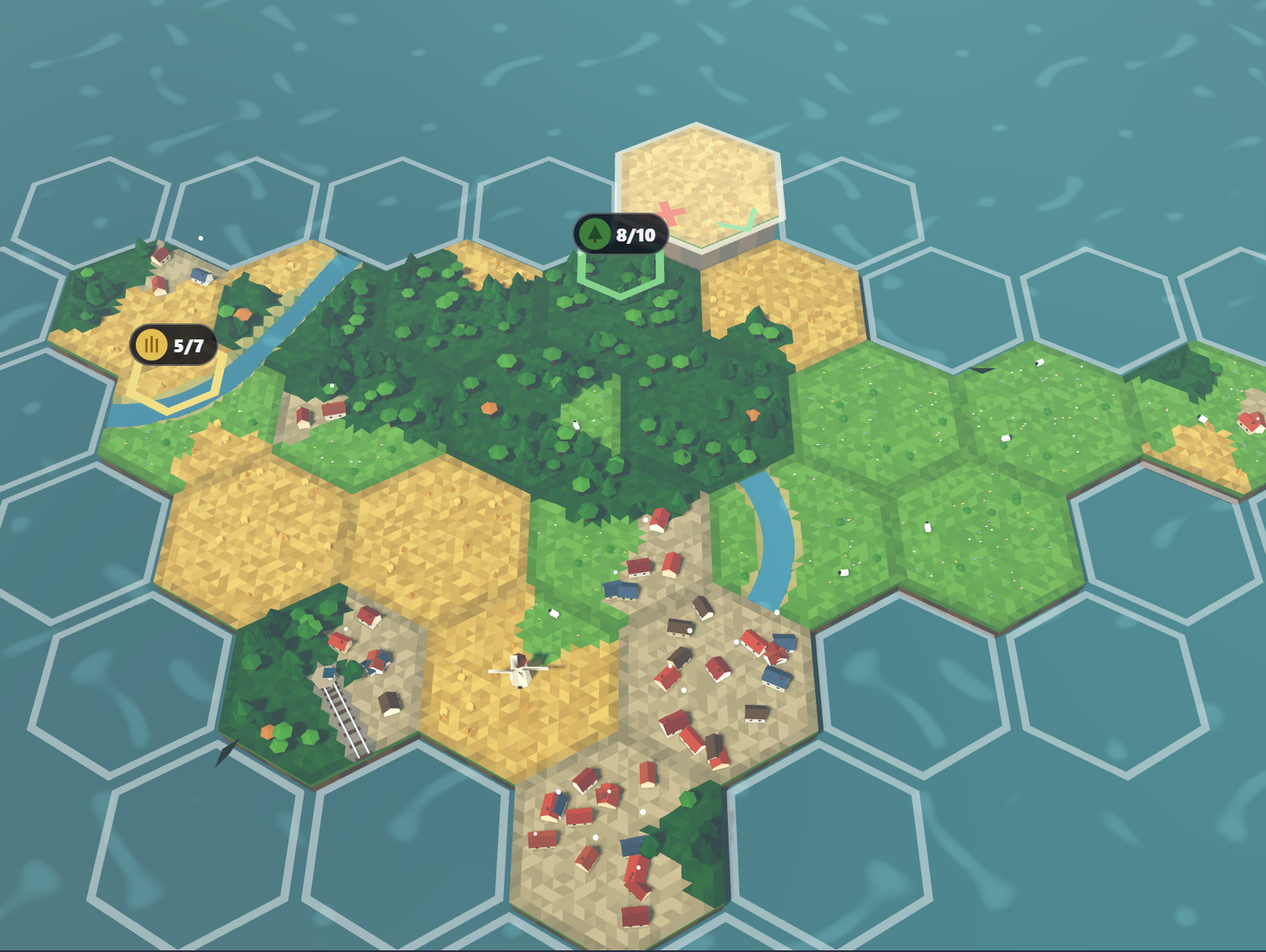
- Meadowfold, strategy: lay hex tiles into a landscape without running out of tiles.
- Thornfield Tactics, strategy: three wardens turn beasts’ attacks away from the hamlets.
- Dragonfly Draft, skill: hold and release to fly through a marsh.
- Quail Cart, skill: gas and brake, with a loose egg in the tray.
- Mossmarch, strategy: a lane battle of fighters that counter each other.
- Rillfall, skill: turn a tower so a raindrop falls through the gaps.
- Oakmoss Draughts, strategy: English draughts against four computer opponents.
- Foxglove Hand, cards: a deckbuilder where every enemy shows its next move.
Burlspin: throw hatchets into a spinning log
Burlspin has one action. Tap, click or press Space and a hatchet flies up into a spinning log. If it lands too close to a hatchet already in the wood, or on an iron nail, that is a strike and costs a heart. Acorns sit on the rim for 25 points each. Throw every hatchet to clear the stage.
There are ten stages. Logs speed up, stall and change direction on set patterns. The Burl Warden at stage 5 starts with nails and reversals, then sheds its bark: a banded shield ring orbits the other way with two openings, so a hatchet has to pass an opening and still miss the blades. After the Warden you choose Mend, an extra heart, or Steady hand, an aim guide for stages 6 to 9. The finale, the Heartwood Crown, ends with a glowing knot you have to hit three times with eight hatchets. It jumps after each hit, and misses stay in the wood as new obstacles. Each run also turns the layout and shifts the nails and acorns a little, so a stage cannot be learned as one fixed rhythm.
What the tiers change:
- Easy: an aim guide that turns red when a throw would strike, logs 30% slower, no nails before stage 8, five hearts.
- Medium: the full rules with three hearts.
- Hard: every acorn must be collected to clear a stage, each stage has an extra nail, and a strike during a boss restarts the whole boss.
- Inferno: Hard’s rules plus short stalls in every spin and shield rings on stages 7 to 9, with two hearts.
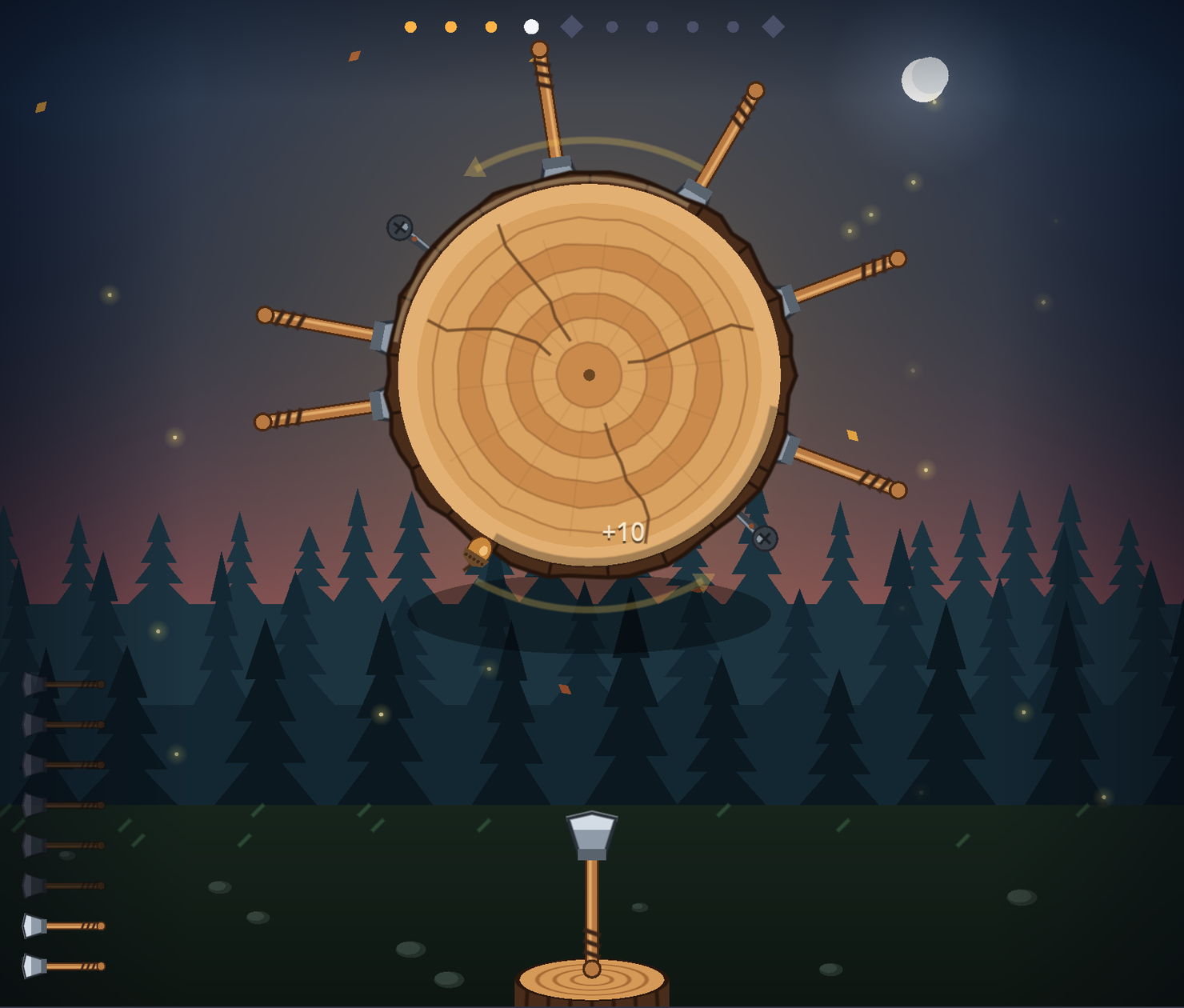
Tip: hold your throw while the arrow is up
Before the log reverses, it shivers and an arrow shows the new direction. On Medium that warning appears 0.6 seconds ahead (0.9 on Easy, 0.35 on Inferno). A gap you pick during the warning may be heading the other way by the time your hatchet lands, so wait until the log has turned and then choose. An amber glow on the rim does the same job for a sudden slowdown. Turnabout, the fourth stage, is the first one built around reversals. In our check on Medium, holding every throw through the warnings cleared it without losing a heart.
Meadowfold: build a landscape one hex at a time
Meadowfold is calmer. You draw a hex tile, turn it and set it beside your landscape. Each tile has six edges of meadow, forest, field, river, village or rail. Every edge that matches its neighbour scores 10. When you hover a spot, chevrons mark the edges that will match and crosses mark the ones that will not.
Tiles with a gold ring start quests, such as a forest of at least a given size. Finishing a quest adds tiles to your stack, and the run ends when the stack is empty. So the score matters, but staying supplied with tiles decides how long you get to keep building.
What the tiers change:
- Easy: 40 tiles, three upcoming tiles shown, and you can undo the last tile.
- Medium: 36 tiles, one preview, and quests that ask for an exact size with the area closed off.
- Hard: 34 tiles, and rivers and rails must continue: each broken river or rail edge costs a tile.
- Inferno: 32 tiles on the day’s seeded board, six blighted hexes to surround for three tiles each, no preview, and only 30 turns of rotation for the whole run.
Tip: fill pockets for perfect fits
A spot touched by three or more tiles is worth studying. If every neighbouring edge matches, the placement is a perfect fit: 20 extra points, and the tile comes back to your stack. In our Easy run, two perfect fits left the stack exactly where it was before each placement, while an ordinary placement costs one tile. Leaving small gaps in the landscape gives you more of these chances later. Turn the tile through all six positions before giving up on a pocket.
Thornfield Tactics: move the blow, not just the beast
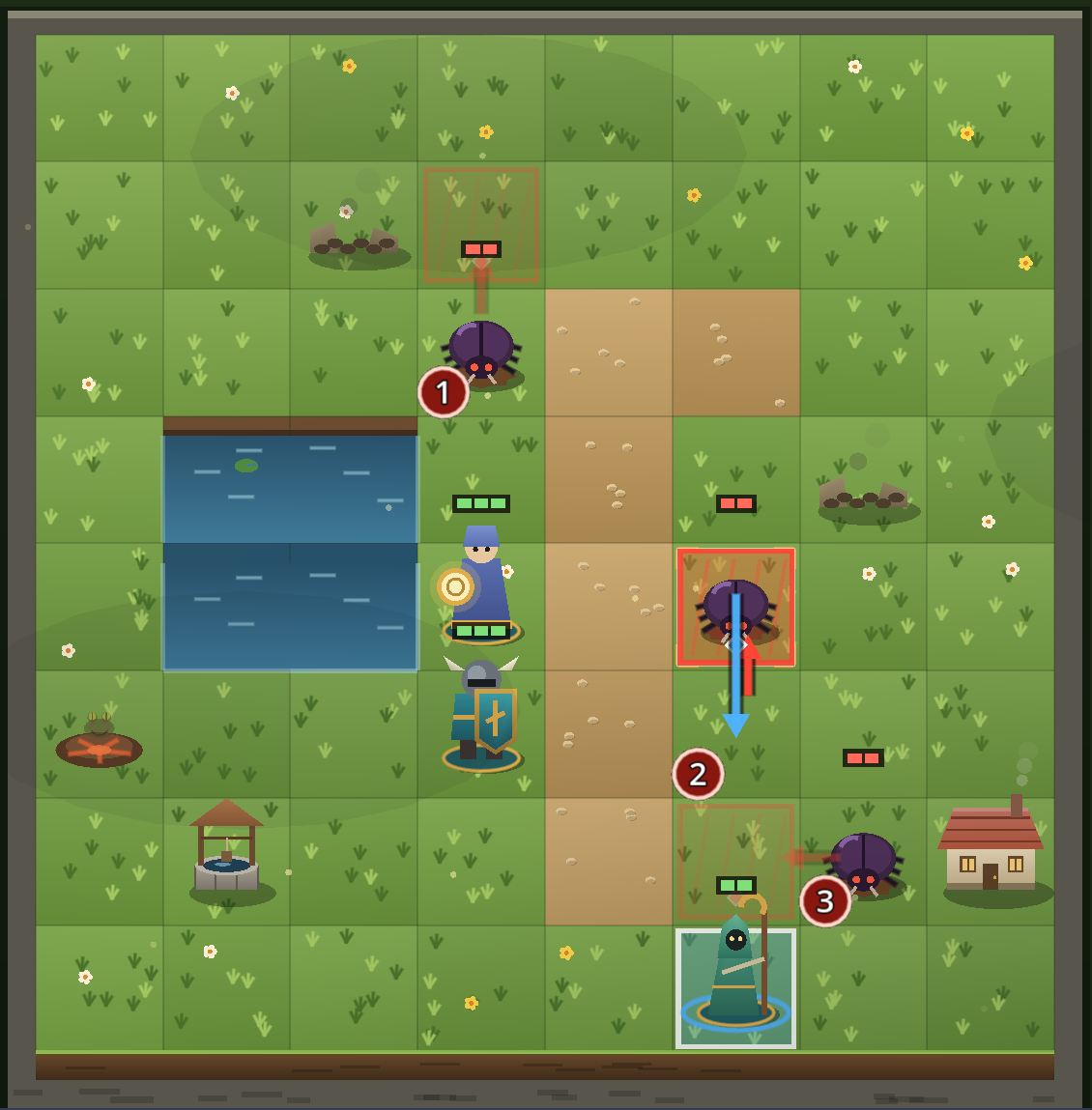
Thornfield Tactics is a turn-based tactics game on an 8x8 hedgerow field. You command three wardens across nine missions on three islands. Beetles, boars, crows and toads show every attack before you move, with numbered badges for the order. The Ploughshield rams for 2 damage and pushes. The Hookreeve’s Hookline deals 1 damage and pulls a beast toward her from two or more tiles away. The Warden can shield a unit, hamlet or well, or push all four neighbours away.
Beasts drown in ponds, bump into hedges and cottages, and hit each other with their own attacks. Every hamlet struck costs Hearth, a pool shared by the whole campaign. The Briar Matron, the mid-campaign boss, roots in place at half health and sends thornwaves down whole lines. The Thornhart finale hides behind heartwood totems that only the blight’s own blows can break.
What the tiers change:
- Easy: 8 Hearth, unlimited turn resets, a lost mission’s retry restores Hearth, elites fight as normal beasts, and bosses have less health and more turns.
- Medium: 6 Hearth and one turn reset per mission.
- Hard: 5 Hearth, one reset per island, extra beast pairings, lost Hearth stays lost, and tougher bosses.
- Inferno: 5 Hearth, no resets or retries, armoured and thorned elites, and new boss patterns.
Tip: a beast’s attack moves with the beast
Attacks are stored as a direction, and they land from wherever the beast is standing when it strikes. Push or pull a beast one tile and its blow moves one tile too, onto empty grass, into a pond or onto another beast. On the first mission on Medium, a Hookline pulled a beetle one tile down, and its marked bite moved down one tile with it. With a mouse, hovering a target previews the result, including the re-aimed attack. On touch, the first tap previews and the second commits.
Dragonfly Draft: hold to rise, release to dive
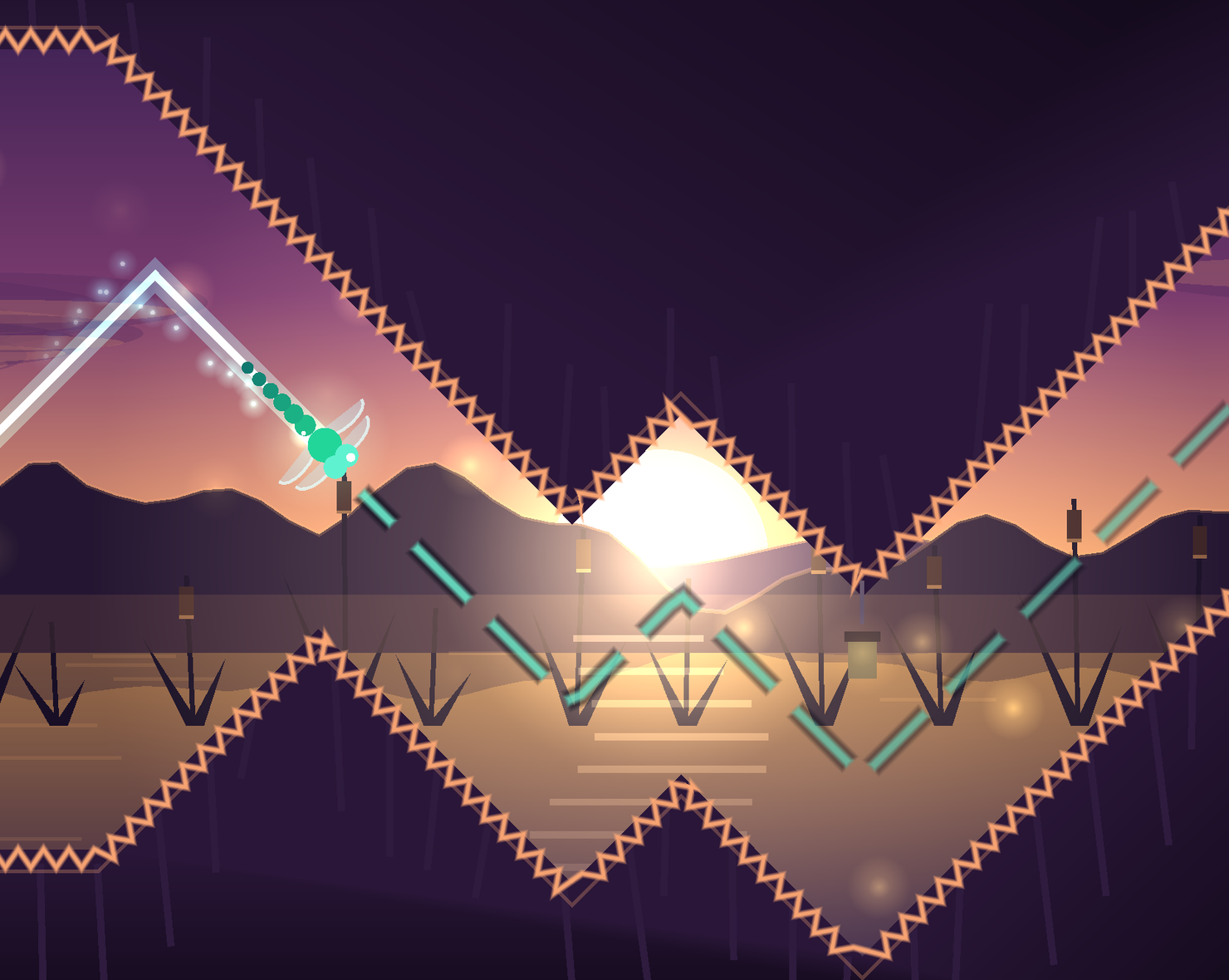
Dragonfly Draft uses one input. Hold the mouse button, a finger, Space, W or Up and the dragonfly rises at 45 degrees. Let go and it dives at 45 degrees. You thread it through six marsh levels at dusk: reed banks with thorny edges, mossy stones, spinning seed burrs and closing lily gates. The Falling Willow brings the old tree down around you midway, and in Heron’s Reach a grey heron stabs along lanes it marks first. A progress bar shows how far you got.
What the tiers change:
- Easy: the widest channels, a glowing guide line on every level, a checkpoint in every section, and only the heron’s simplest attacks.
- Medium: narrower channels, the guide on the first level only, a checkpoint every second section, and a heron that stabs two lanes at once.
- Hard: no guide, two checkpoints per level, gravity-flip and speed portals, and a third heron phase.
- Inferno: no checkpoints at all, plus mirrored stretches where the course is flipped and the controls are inverted.
Tip: after a crash, take a breath
You restart at the last checkpoint, and the dragonfly waits there until you press. Nothing scrolls in the meantime. In our check on Easy, a crash in Reed Shallows put the dragonfly back at the 30% checkpoint, where it stayed still for two full seconds until the next press. Use that pause to look at the shape of the next stretch before committing. Easy has a checkpoint in every section, so a mistake never costs much there.
Quail Cart: drive a farm cart with a loose egg in the tray
Quail Cart has two pedals. Gas drives forward; brake slows you and reverses once you have stopped. A speckled egg rolls freely in a shallow straw tray. It cracks if it hits the tray too hard, touches the ground or is struck by a boulder, or if the cart ends upside down. Every hard knock also adds lasting stress to the shell, shown by a Shell meter, and enough of it cracks the egg too.
There are five stages. Meadow Lane teaches the pedals. Orchard Rise adds root humps. Rockslide Ravine has rockslides and then a swaying rope bridge. Millpond Hollows adds mud and ledges. Storm Ridge brings headwinds and tailwinds and ends with stopping the cart inside the summit nest. Seeds you pick up buy new paint for the cart, which is cosmetic only. Long Road is an endless mode that gets harder the further you go.
What the tiers change:
- Easy: a taller rim on the tray, more checkpoints and longer warnings.
- Medium: the stages as designed.
- Hard: gusts and loose scree on earlier stages, and one checkpoint.
- Inferno: two eggs in a wider tray, rockfalls in pairs and on every stage after the first, and tailwinds as well as headwinds.
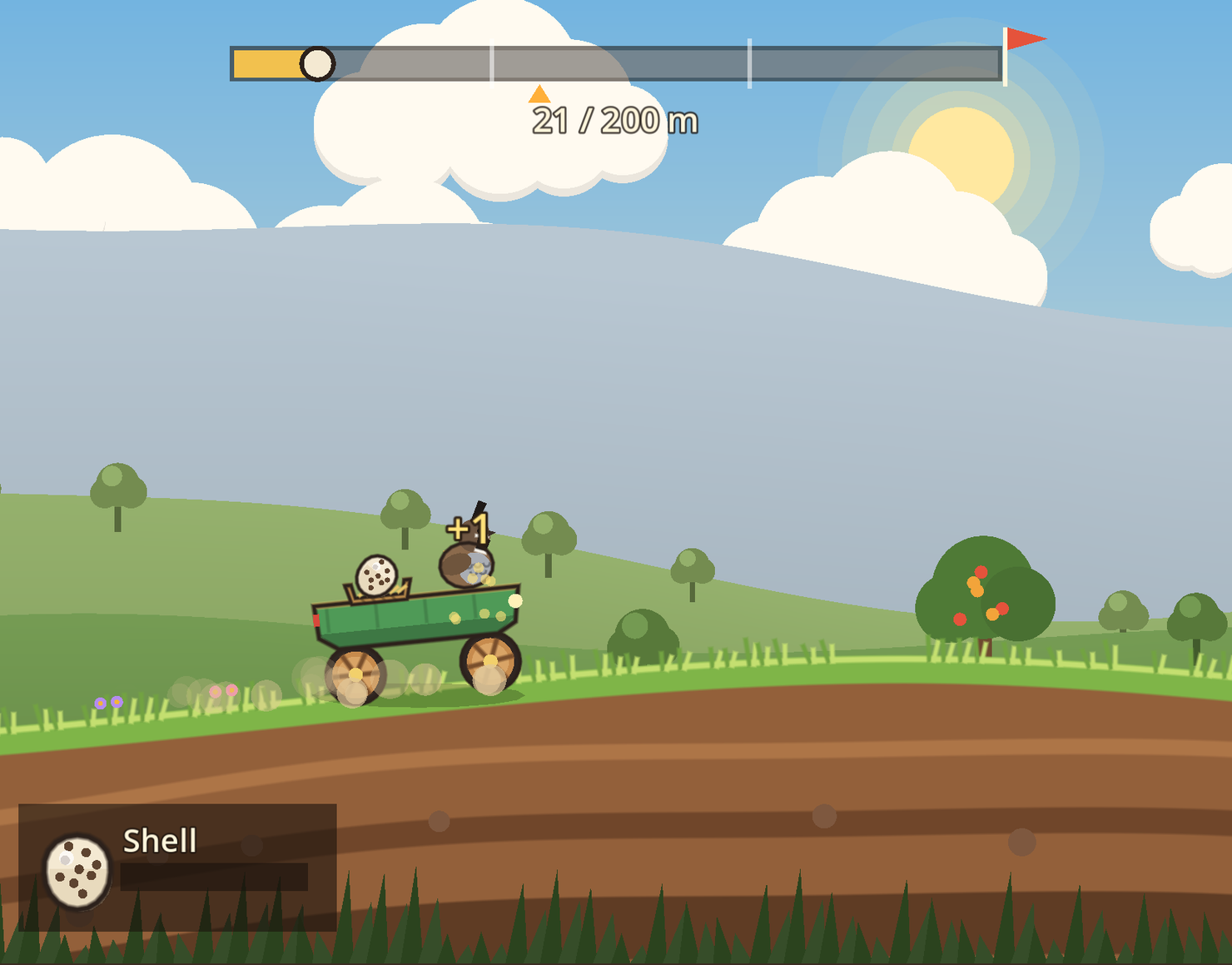
Tip: slow over the humps, fast under the rockfall
On Orchard Rise, holding the gas down the whole way cracked the egg on the root humps less than a fifth of the way in. Driving at a steady, careful speed got past the humps but was caught by the rockfall at about 39% in every steady run we tried. The rockfall starts when you reach its roadside sign: the lip shakes and sheds pebbles, then drops a boulder that rolls back down the road. Stopping underneath it is fatal. What cleared the stage was driving gently over the bumps, then speeding up as the sign came into view and keeping the gas down until the cart was past the lip. Ease off again afterwards, because the egg is still loose.
Mossmarch: send the fighter that beats theirs
Mossmarch is a lane battle. Two burrows face each other across a forest lane, and moss grows over time for you to spend. You have four fighters, and each one beats another. Shell beetles crush hares. Hares leap the front line to reach throwers and snails. Snails sling boulders that crack beetles and gates, but cannot hit anything close. Throwers shoot at range and are the only fighters that can hit something flying. You can also grow your gatherer for more moss, upgrade a spitter on your burrow, hold your warband at a flag or send it marching, and use Rootsnare to root the enemy crowd nearest your burrow.
There are eight battles. Ironbark, halfway through, is a siege tortoise that digs in at half health and exposes its back to hares. The Hollow Queen, the finale, answers any warband that leans too heavily on one kind of fighter.
What the tiers change:
- Easy: the Rotwood sends its fighters in turn, its moss grows slowly, and a Counter tag marks your answering button.
- Medium: the Rotwood reads your army and builds counters to it, and sounds war-horn raids.
- Hard: it also musters groups of three, uses a Rot surge, and the bosses’ attacks overlap.
- Inferno: authored elite waves, a smaller moss reward for kills, and a leaner start.
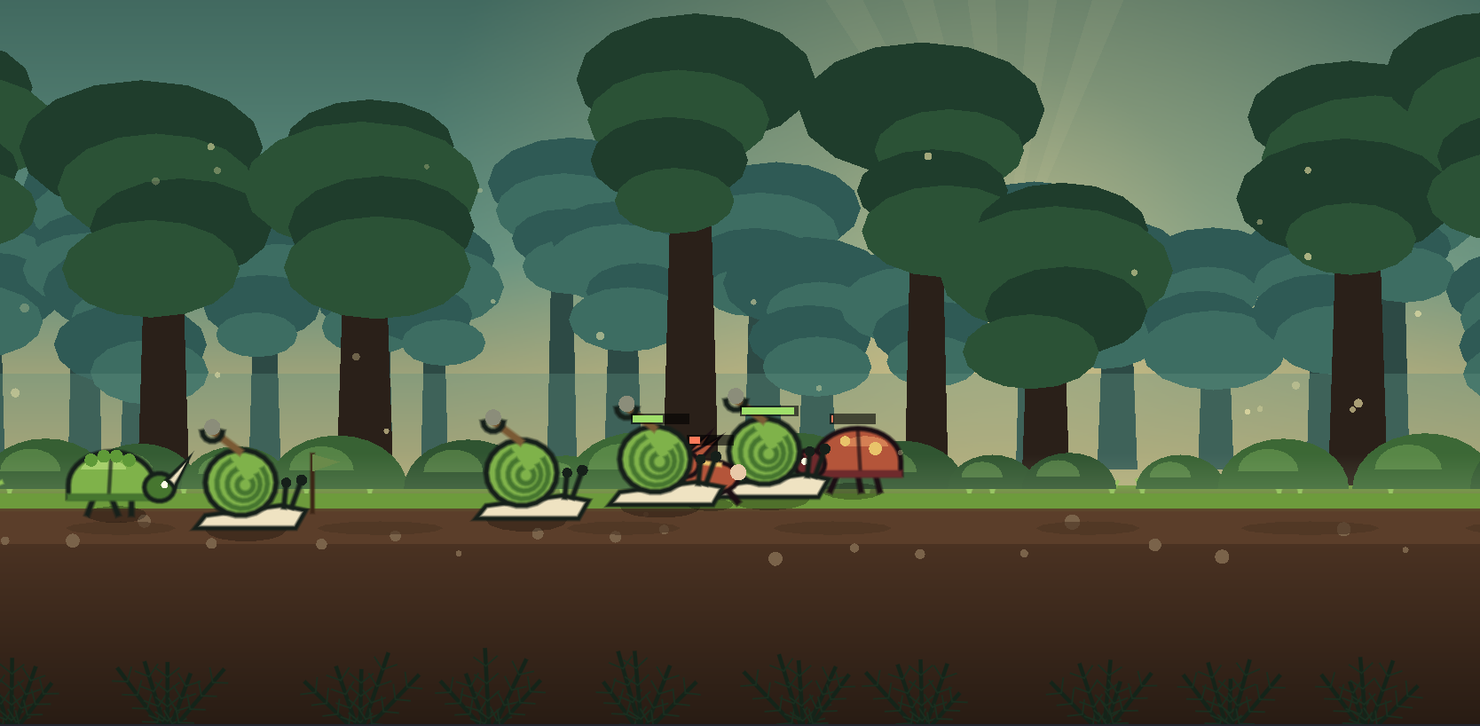
Tip: on Easy, follow the Counter tag while you learn the table
When the Rotwood commits to one kind of fighter, the button that answers it lights up with a COUNTER tag. In our Fernbank battle on Easy, sending only the tagged fighter, plus one gatherer upgrade, took the burrow in 2 minutes 9 seconds. The tag pointed at snails and beetles in that battle. On Medium the tag is gone and the Rotwood counters you instead, so the habit to build on Easy is noticing which kind is coming and why the tag chose its answer.
Rillfall: turn the tower, let the raindrop fall
Rillfall is a tower you turn. Drag sideways, or hold the arrow keys, and a bouncing raindrop drops ring by ring through the gaps. Thorny briars end the run. Fall through three rings without bouncing and the drop becomes a downpour, which smashes the next ring, briars included.
Each tier has eight towers. The Millrace, halfway up the list, has sluice shutters that open and close and turning mill wheels. The Storm Spire finale strikes columns of the tower with lightning after a warning, and in its second phase it aims at the column the drop is in. Endless Downpour builds a new bottomless tower every run.
What the tiers change:
- Easy: wide gaps and a one-use leaf shield.
- Medium: narrower gaps and no shield.
- Hard: fragile leaves that give one short hop and crumble, and rings that turn on their own.
- Inferno: shutters that close into briars, some single-segment gaps, and a downpour that needs four rings instead of three.
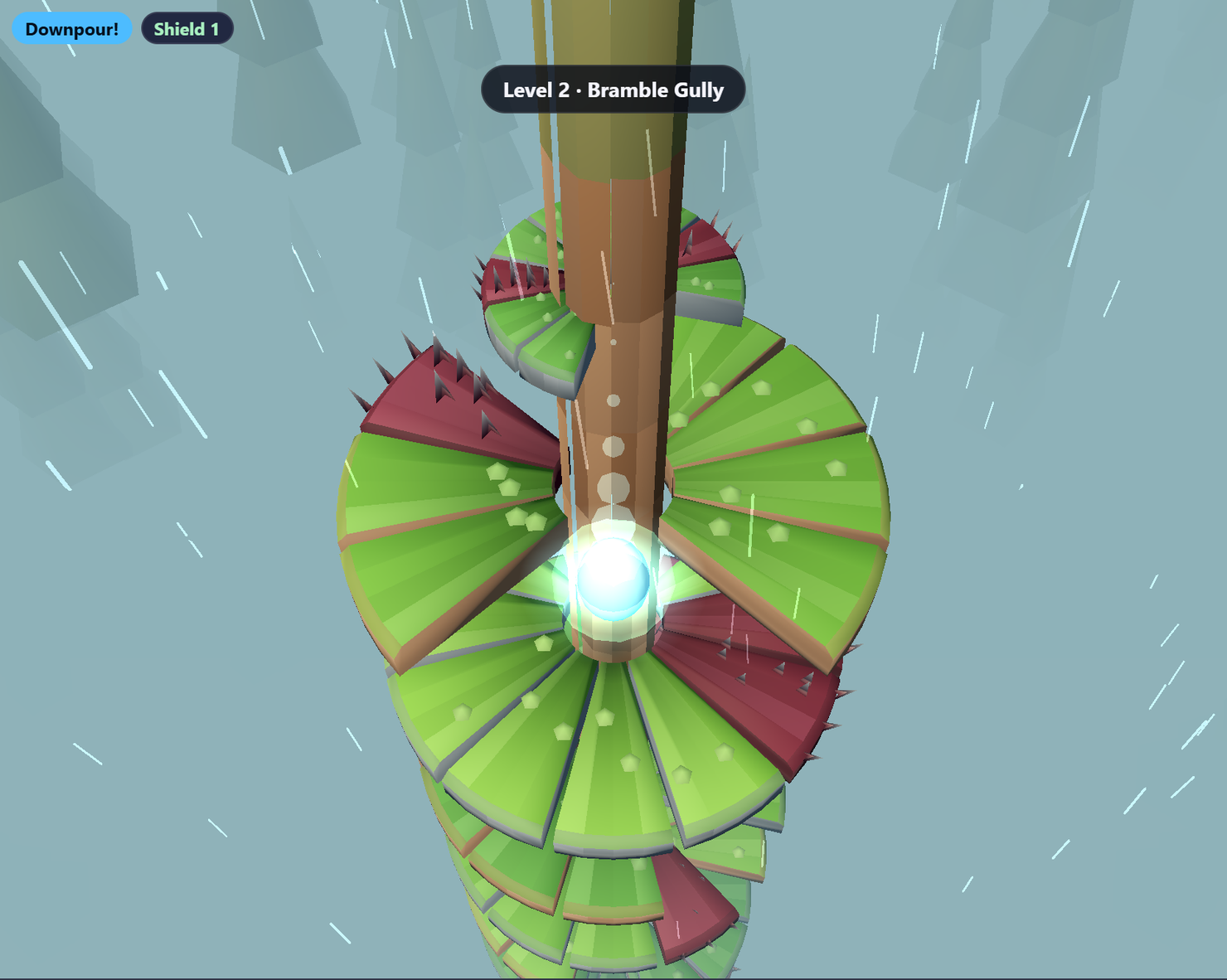
Tip: chain gaps instead of looking for safe landings
Each bounce resets the count, so a run of gaps in consecutive rings is what builds a downpour, and a downpour goes straight through a ring even when it is full of briars. When the ring below is mostly thorns, that is the moment you want the downpour. In our run of the first Easy tower, the drop fell through three rings in a row, triggered a downpour and cleared the tower. The count resets after a smash, so aim the next landing again.
Oakmoss Draughts: English draughts on a forest-floor board
Oakmoss Draughts is standard English draughts, also called American checkers, with acorns against oak galls. You play the acorns and move first. Captures are compulsory, a jumping piece keeps jumping, and reaching the far row crowns a king and ends the move. Forty moves each without a capture or a man moving, or the same position a third time, is a draw. Glowing rings mark your acorns that can move, and they turn amber when a capture is compulsory.
Each tier is a different computer opponent:
- Easy looks one move ahead and makes some careless moves. You get hints and unlimited undo.
- Medium searches four moves with a simple plan for converting a lead. You get three undos.
- Hard searches six moves and judges positions. You get one undo.
- Inferno searches deeper to a fixed budget and knows endgames. No undo.
Twelve Problems ask you to force a win in two to five moves against the strongest opponent.
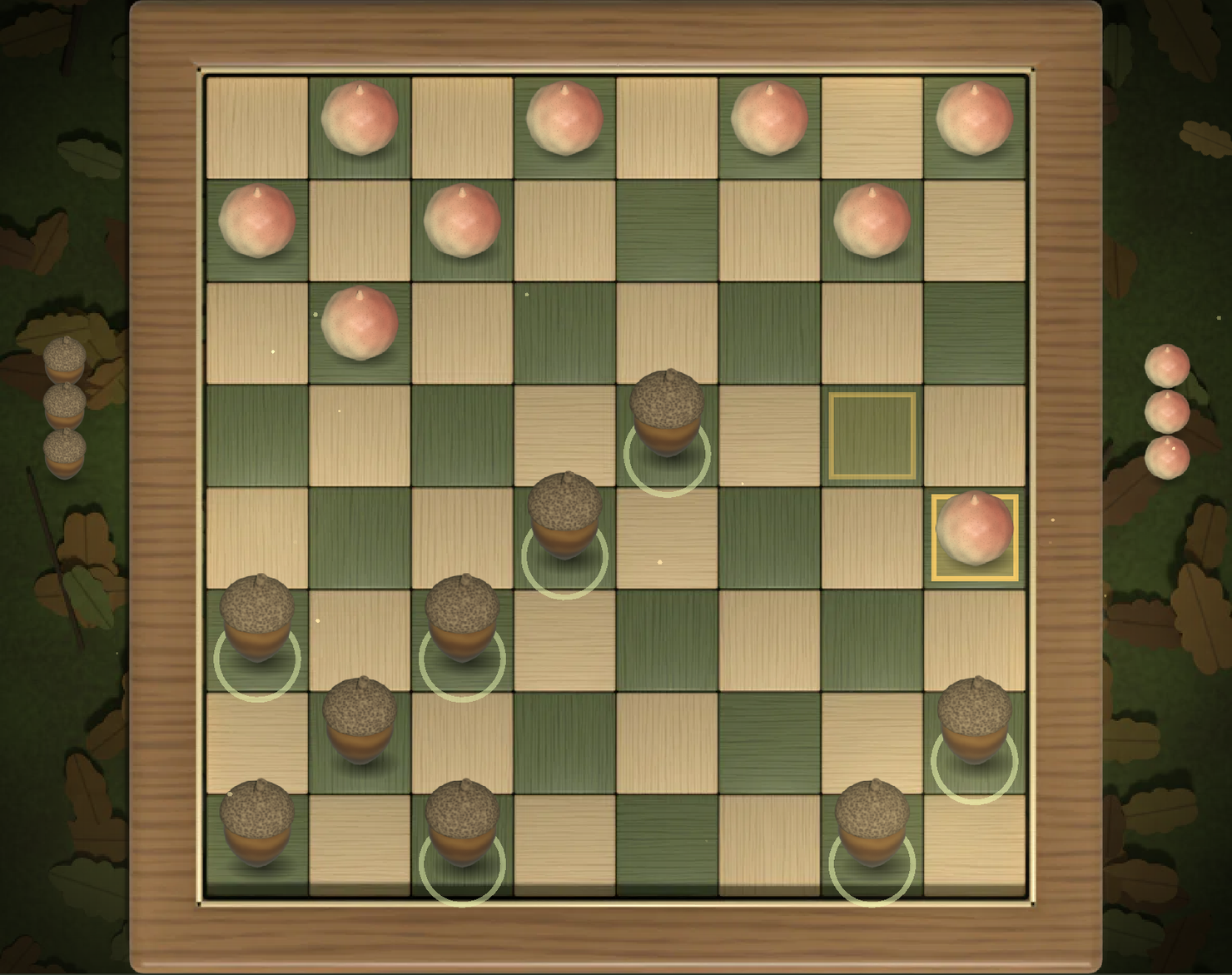
Tip: in the Problems, look for a move that leaves them one reply
Because captures are compulsory, you can sometimes choose the galls’ move for them. In five of the twelve Problems, the winning first move is a quiet move after which the galls’ only legal reply is a capture. If a Problem looks stuck, check each of your moves for that: what can the galls do next, and is it only one thing? We solved the first Problem, Acorn Drop, this way in the browser against the game’s own defender.
Foxglove Hand: read the intent, then spend the rest
Foxglove Hand is a deckbuilder. Your hedge-witch starts with ten cards, draws five a turn and has three energy to spend. Every enemy shows what it will do next, so you can see how much damage is coming before you decide. After each fight you pick one of three new cards or skip. Along the way you find charms, rest at campfires to heal or upgrade a card, and spend gold at the tinker’s cart. Three acts end in bosses: the Hollow Stag, the two-phase Rootmother and the Withering Queen, whose Briar Hide stops small hits while Venom still works. Runs use a random seed or the shared daily seed, and the game saves after every move.
What the tiers change:
- Easy: you see each enemy’s next two intents, start with 80 HP and get one free card removal.
- Medium: 68 HP and slightly softer enemies.
- Hard: full-strength enemies, and elites gain an affix: Armored, Swift or Venomous.
- Inferno: elites carry two affixes from act 2, every boss gains a third phase, and each act adds a Blight curse.
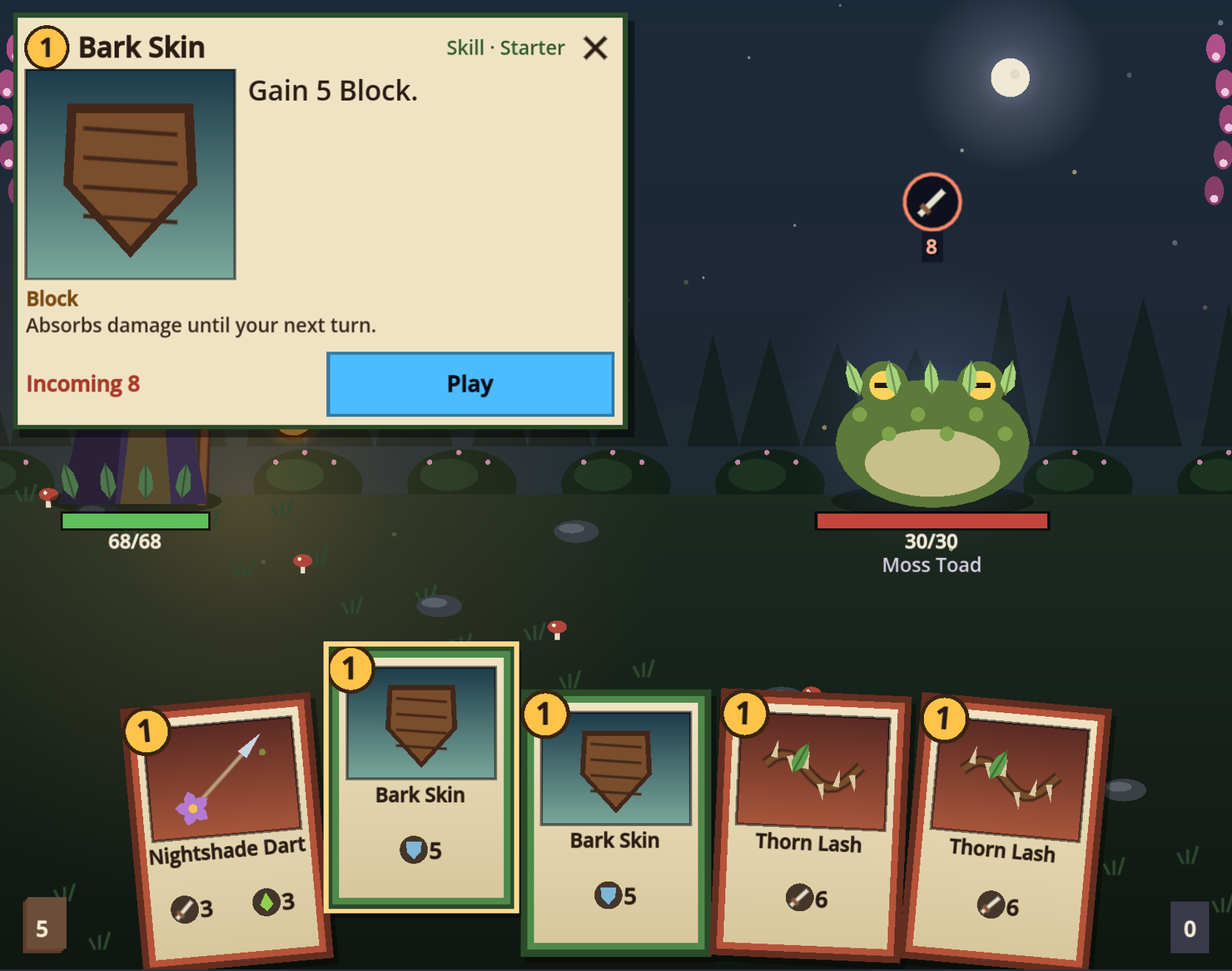
Tip: block what is coming, not more
Block absorbs damage only until your next turn, so block beyond the incoming number is wasted. Play enough to cover the intent, then spend the remaining energy on damage. In the fight above, two Bark Skins gave 10 block against the toad’s 8, and the witch finished the fight at 68 of 68 HP. When an enemy’s intent shows no attack, that is a turn to spend everything on damage or powers.
Where your progress goes
All nine keep your progress, records and unlocked content in the browser you play in, as long as it allows storage. If it does not, the games still play and tell you that progress will not be kept.
Each tip was checked on 28 September 2026 against version 1 of each game, in desktop Chrome with ordinary mouse and keyboard input. Touch controls and phones were not part of this check. Screenshots show the actual game state at the moment described, cropped to the play area.