
Puzzle & logic Game guide
How to solve a nonogram without guessing your way through it
Learn to read clues, find overlaps and use empty squares as evidence, with a worked opening from Lantern Nonogram.
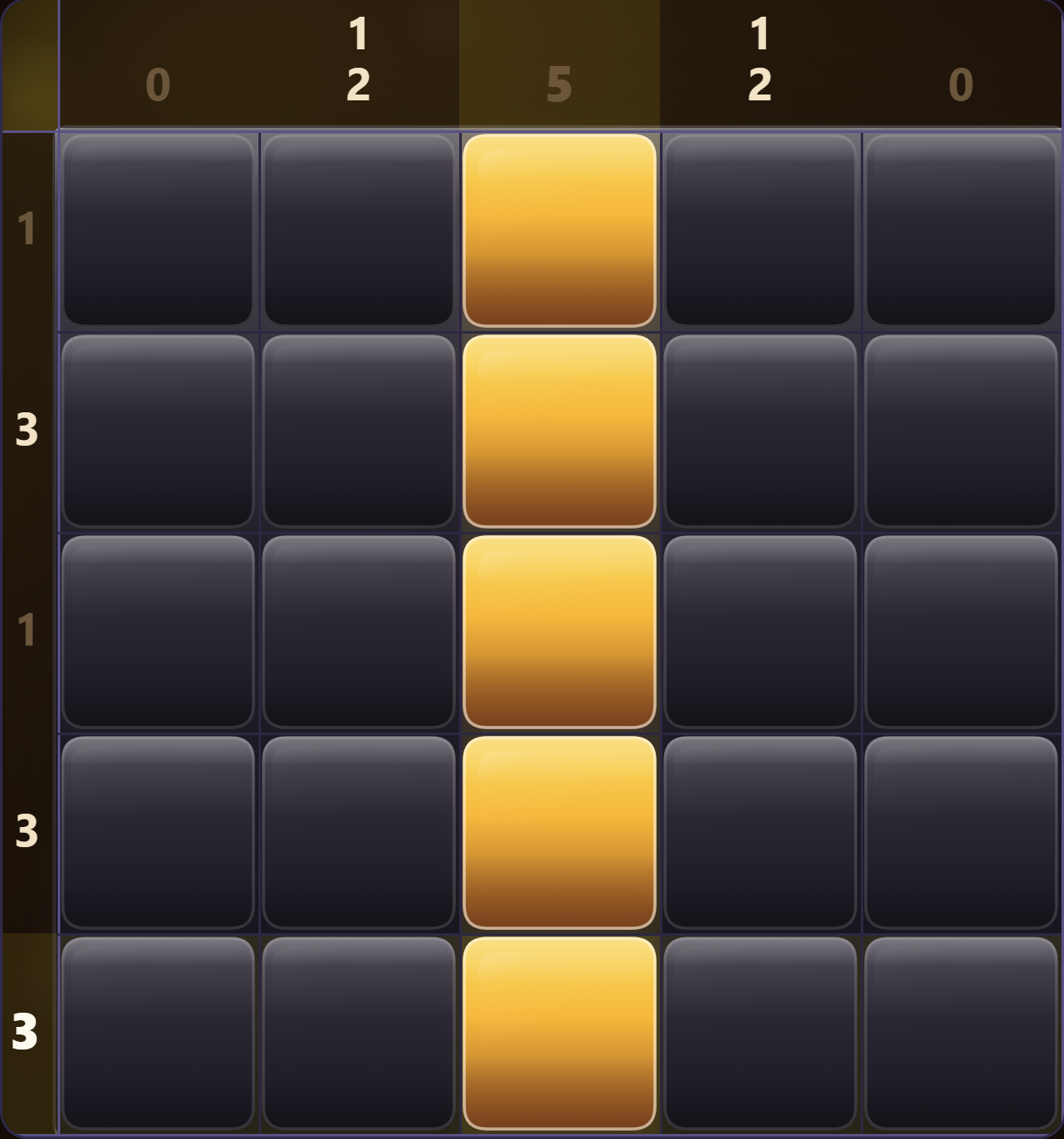
Start a nonogram by looking for a square you can prove is filled or empty. Guessing at the picture may get you a few correct squares, but one wrong guess can send the rest of the board off course.
Each mark helps you read the line crossing it. You can build up the picture one deduction at a time, even when you have no idea what it depicts.
We’ll work through the opening puzzle in Lantern Nonogram, our picture-logic game. The walkthrough reveals its final picture, so skip that section if you’d like to solve it yourself.
Read each clue as a sequence of blocks
A clue of 3 means one uninterrupted block of three filled squares somewhere in that line. A clue of 1 2 means a single filled square, followed by a separate block of two. There must be at least one empty square between those blocks. The clues beside a row run from left to right; the clues above a column run from top to bottom.
The order matters. A line containing two filled squares, a gap, then one filled square matches 2 1, not 1 2. And 1 1 does not mean “fill any two squares”: joining them makes a block of two, which is a different clue. These are the standard monochrome rules described by puzzle publisher Conceptis in its Pic-a-Pix rules. Colour nonograms can have different separation rules; Lantern uses the monochrome logic even though completed pictures reveal in colour.
A 0 means the whole line is empty. Mark it now so you don’t have to check it again.
Start with lines that leave the least room
Look for a clue that fills its entire line. On a five-square board, a 5 settles every square in that row or column. You can also find a completely determined line with several blocks. In five squares, 2 2 uses two filled squares, one compulsory gap and two more filled squares. There is no room to slide anything.
For more complicated clues, count the filled squares and the minimum gaps. A line of ten with 4 3 needs eight squares: four filled, one gap and three filled. That leaves two spare squares to distribute before, between or after the blocks. It is not a complete answer, but it tells you how tightly packed the line must be.
Compare each clue with the space available. A 7 in a fifteen-square line has much more room to move than a 4 in a five-square line.
Use overlap when a block can move
Imagine a five-square row with the single clue 3. Pushed all the way left, the block covers squares 1, 2 and 3. Pushed all the way right, it covers 3, 4 and 5. Square 3 is filled in both extremes, and in every position between them. You can fill the middle square immediately.
Now try 4 in the same line. Its possible positions are squares 1–4 and 2–5. The middle three squares overlap, so all three are certain. The ends remain undecided. Resist filling them simply because they seem likely.
With several blocks, work out the possible positions of each particular block, including the space required by its neighbours. Do not compare a square covered by the first block in one arrangement with a square covered by a different block in another and assume the whole block is fixed. The useful question is always: does every legal arrangement agree about this square?
A real opening: the first First Light puzzle
Open Lantern Nonogram and choose the first tile in First Light. Its board is five by five. Before touching anything, read the column clues. The middle column is 5, while the outermost columns are both 0.
Fill the five squares down the middle. Mark the first and last columns empty. You have now learned fifteen squares from three clues, without making a guess or recognising a shape.
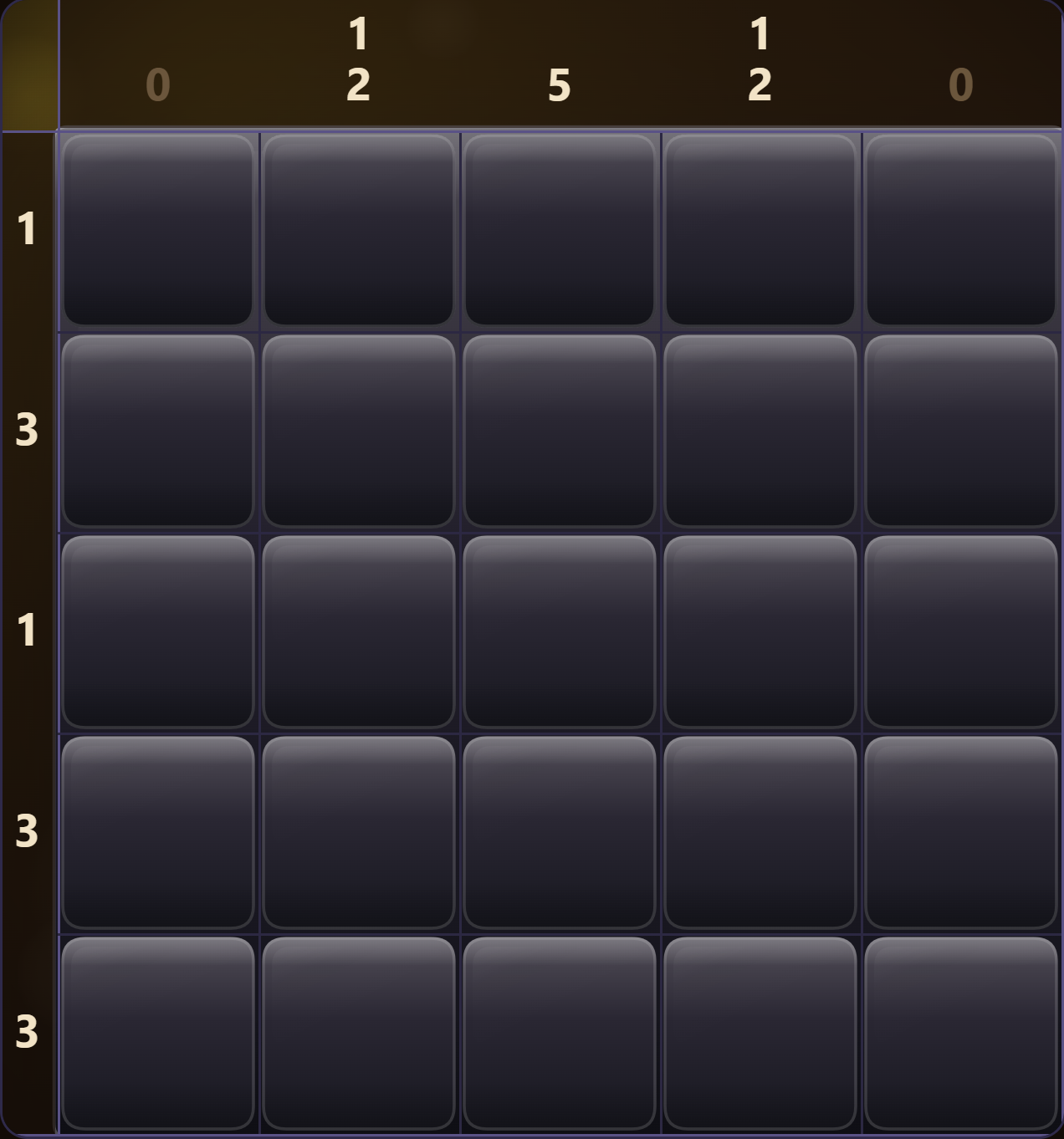
The first row has clue 1. Its middle square is already filled, so its remaining squares must be empty. The third row works the same way. Rows two, four and five each have clue 3. Because the outer columns are empty, the only remaining three-square block occupies columns two, three and four.
Check the two unfinished columns. Each contains one filled square, a gap, then two filled squares: 1 2, exactly as printed. You’ve finished Candle.
Empty marks prevent repeated work
An unfilled square can mean two different things: “I have not decided” or “I know this is empty.” Keep those meanings separate. In Lantern, switch to Mark to record an empty square; desktop players can also use the right mouse button. Switch back to Fill when you return to painting blocks.
Once a block is complete, consider its neighbours. If the clue says a block of three and you have identified all three squares, extending it would break the clue. Any adjacent square inside the line must be empty. Those little boundary marks often unlock the next column.
Be careful when a line has several equal clues. A visible pair of squares does not automatically tell you which 2 it belongs to. Marking a boundary too soon can rule out the correct arrangement. When the identity of a block is still uncertain, leave that boundary undecided.
Getting unstuck without making the board worse
First, reread the lines touched by your latest move. A deduction often creates another deduction nearby, rather than on the opposite side of the board. Then check for a missing separator or a finished block that has not had its neighbours marked empty.
If you discover a mistake, use Undo instead of rebuilding the whole puzzle from memory. Lantern also offers Check and Reveal Cell. They are useful learning tools, but assistance affects the star rating. Treat a reveal as a question to investigate: why does that square fit both its row and its column?
The game labels some later pictures advanced. Do not assume that every picture can be completed by repeatedly applying the simple line techniques in this article. A unique answer and an easy deduction path are different promises. Start with the opening puzzles in a pack and move up when the checks become less necessary.
Try explaining each of your first five marks on the next board. If you’d like another small puzzle to practise on, the daily puzzle guide covers Tile Mosaic.
Guide checked against Lantern Nonogram v2 on 23 September 2026. The Candle example was completed through ordinary mouse input; the partial board was also reloaded to verify its local save. Screenshots are from that session.