
Puzzle & logic How to play
A guide to the three daily puzzles: lanterns, mosaics and pipes
Three boards, three ways of thinking. Learn a reliable opening for each Daily Puzzle, plus how par, undo, dates and streaks work.
The Daily Puzzle rotates between Lantern Lights, Tile Mosaic and Spring Pipes. Each date has its own board. You might be lighting lanterns today and connecting pipes on another visit.
The three puzzles need different approaches: watch how taps combine in Lantern Lights, use clues to place fills in Tile Mosaic, and trace connections from the water source in Spring Pipes.
You can reopen How to play whenever you need a reminder. Below are opening moves to try in each puzzle.
Lantern Lights: think about toggles, not individual lamps
The goal is to light all 25 lanterns on the five-by-five board. Tapping a lantern flips its state and the states of its immediate neighbours above, below, left and right. At an edge, only the neighbours actually on the board are affected. Diagonal lanterns are untouched.
A tap can light the lantern you chose while turning a lit neighbour dark. Check the whole group affected by a move.
Two taps on the same lantern cancel one another. More generally, it is the set of lanterns tapped an odd number of times that matters, rather than the order of those taps. That makes frantic tapping unhelpful: a long sequence may accomplish exactly what a much shorter one does. The underlying idea is shared with the classic Lights Out puzzle; Jaap Scherphuis’s mathematical explanation discusses its toggle structure and row-by-row solving. Our goal is all lights on, so read the dark lanterns as the ones to clear from your problem.
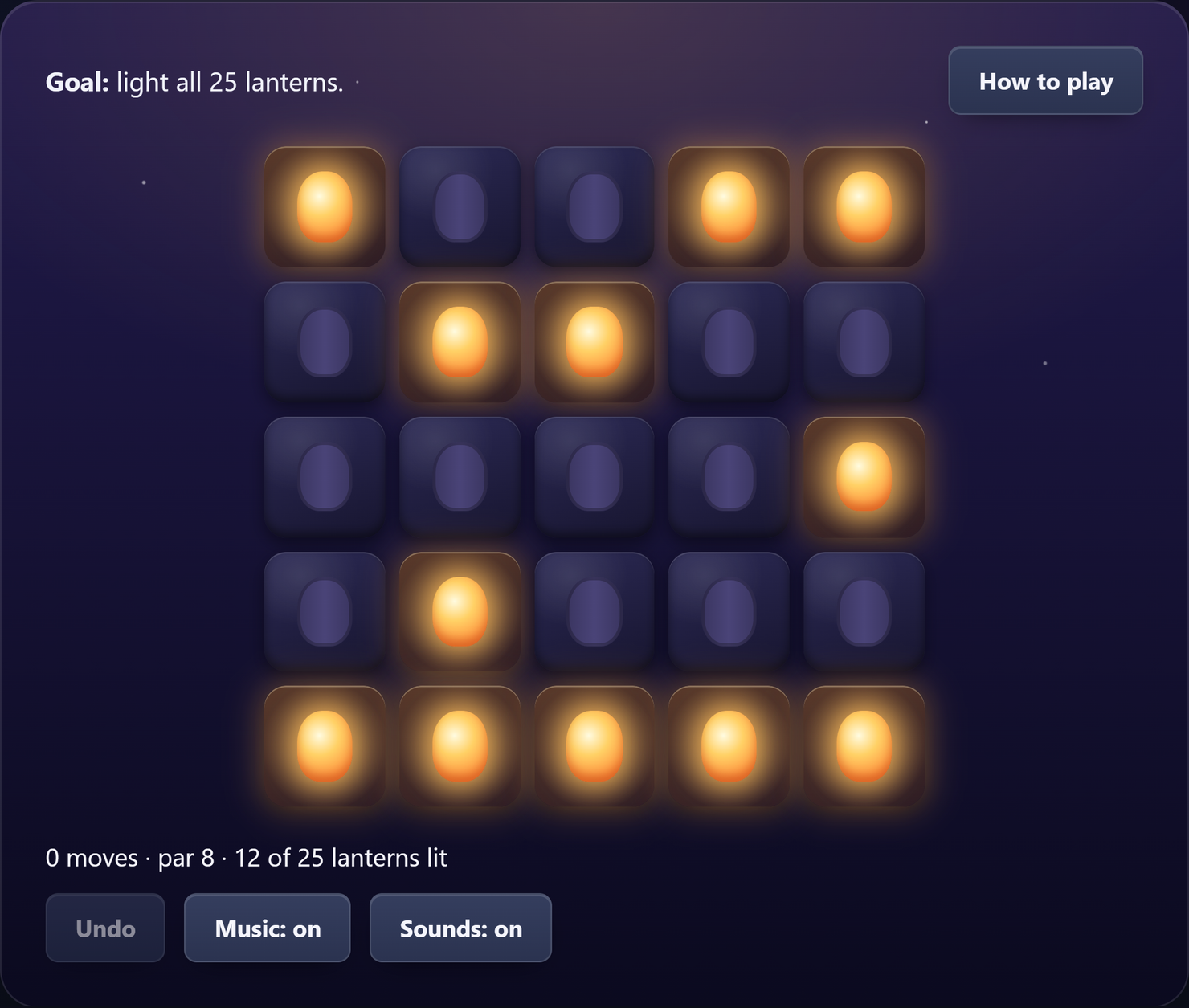
Try working down from the top. For each dark lantern in the first row, tap directly below it in the second row. That changes the target lantern without reaching a row above the first. Once the first row is lit, use taps in row three to fix dark lanterns in row two. Continue downward without disturbing the rows already settled.
The bottom row is the catch. If darkness remains there, the opening choice was not right; you cannot fix it by going below the board. Undo back to the beginning, try a different set of taps in the top row, then repeat the downward process. The method turns an unstructured search into a small set of opening decisions. It does not promise that leaving the first row untouched will solve every date.
Tile Mosaic: a gap is part of the clue
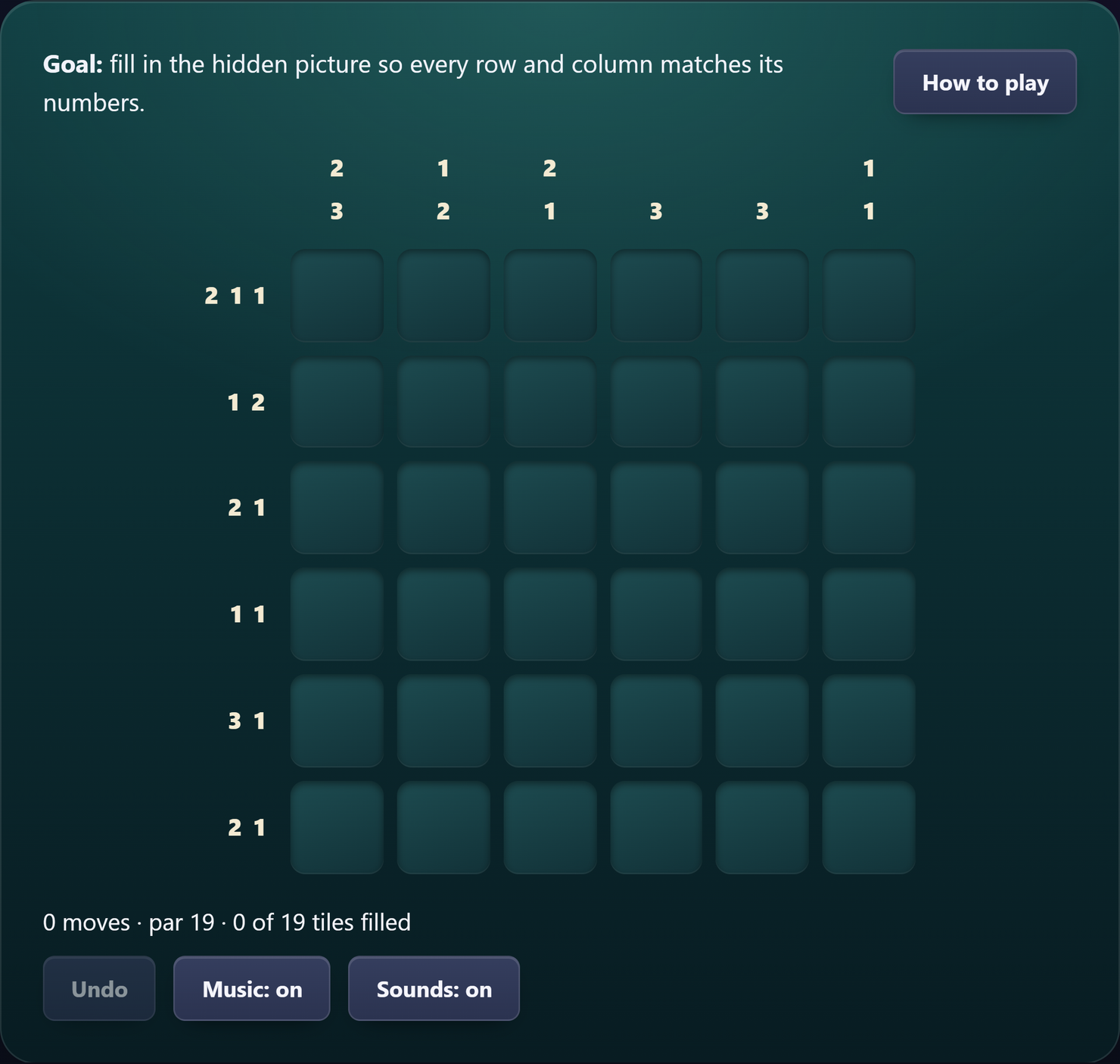
Tile Mosaic is a six-by-six picture-logic puzzle. Each number gives the length of a filled block. Several numbers in a line mean several blocks, in order, with at least one empty tile between adjacent blocks. Rows read left to right; columns read top to bottom.
On the September 23 board pictured above, the first row reads 2 1 1. Count it: two filled tiles, a gap, one filled tile, a gap, one filled tile. That uses all six positions. The entire row is fixed before you consult a single column.
The first column reads 2 3, another exact fit in six cells: two filled, a gap, three filled. Combining the two lines gives a useful opening. This is the habit to practise: count required gaps alongside required fills, and look for lines with no spare space.
Tap a tile once to fill it, again to place an empty marker, and a third time to clear it. The empty marker is a note, not part of the hidden picture. Marking known empty tiles can make the board much easier to read, even though it adds taps to the move count. Clues fade when the line matches; every row and column must agree for the board to be solved.
If no line fits exactly, look for overlap. A block of four in six cells must cover the middle two cells wherever it sits. Fill those two, then inspect the crossing columns. The full nonogram guide works through the same reasoning on a smaller board.
Spring Pipes: build a network from the source
In Spring Pipes, tapping a tile rotates its pipe clockwise by a quarter turn. Water begins at the spring. Your goal is to make that water reach every pipe tile with no open joints, rather than simply produce a tidy-looking collection of connected pairs.
Start by locating the spring and following the blue, flowing sections. A pipe touching another pipe is useful only when both pieces have openings facing each other. A line that looks close but meets the closed side of its neighbour is not connected.
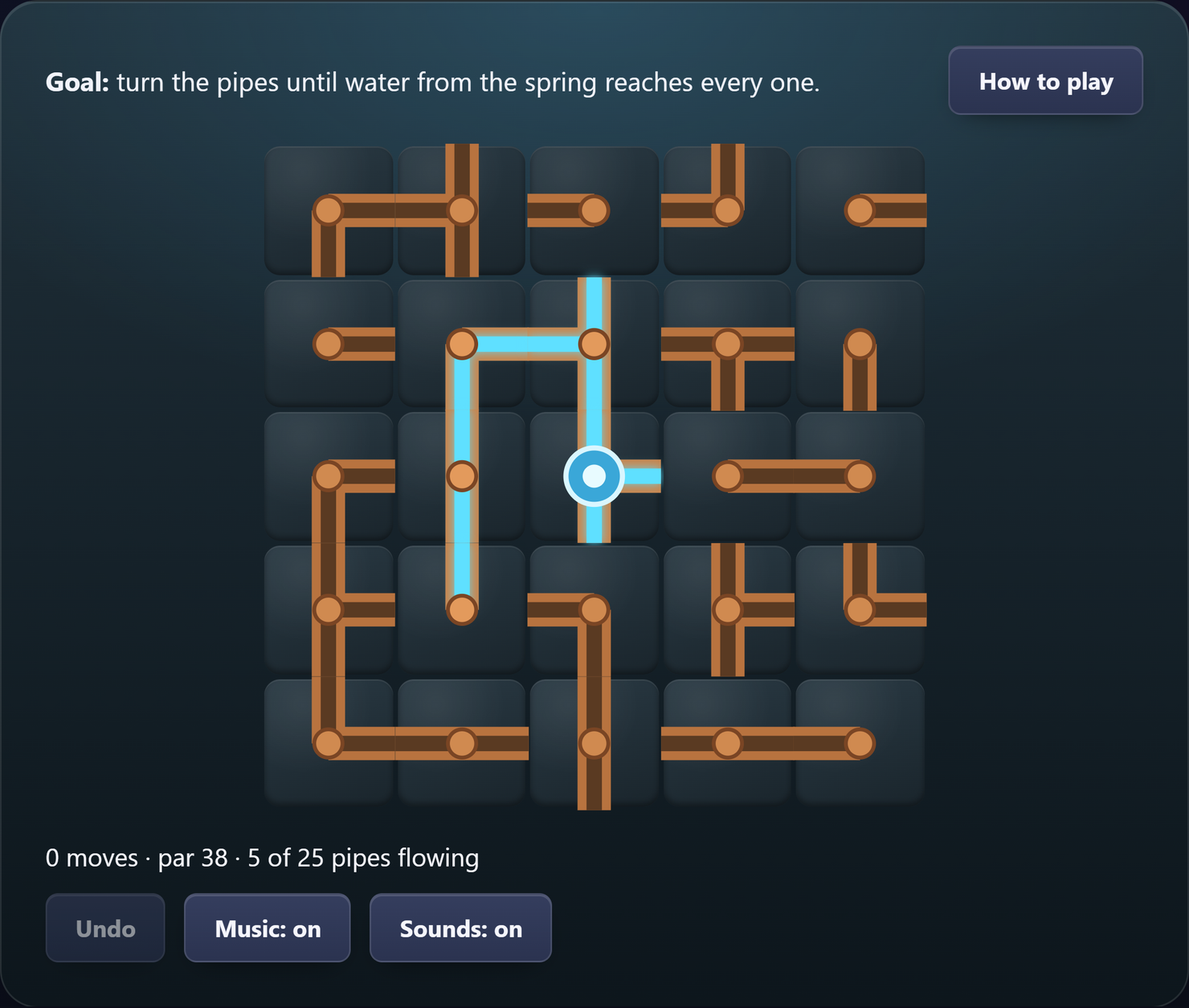
Endpoints have one opening, bends have two, and junctions can connect several directions. Use these shapes to narrow the possibilities, especially near the boundary. An outward-pointing opening cannot find a neighbour beyond the board, so turn it inward. Every opening must meet a matching opening on a neighbour: reaching all the tiles is necessary, but an open joint still prevents a solve.
After each rotation, check whether you disconnected a branch while joining another. Keep working along the boundary between blue and dry pipes until every tile connects to the spring.
Par and undo are feedback, not an entry requirement
All three puzzles count moves and offer Undo. Aim to solve the board before trying to beat par. In Tile Mosaic, marking known empty cells helps you reason through the board, even though those taps add to your count.
Par is a reference value for the generated puzzle. It is not a time limit, and it does not turn a completed board into a failure. In Spring Pipes, another valid network may differ from the one used to generate that reference. Avoid interpreting par as a proof that no shorter route exists for every puzzle type.
Undo accidental taps while you still remember the previous state. When testing an idea, make a few moves and check the result before going further.
Dates, streaks and coming back tomorrow
The board changes at midnight UTC. Everyone opening the same date gets the same generated puzzle, so check the date when comparing results across time zones.
Solving today’s puzzle counts toward the streak. Replaying an older dated board lets you practise, but does not extend today’s streak. Progress and streak records are kept in this browser; do not assume that opening a link on another device brings the same local record with it. Our browser-save guide explains the distinction.
After a solve, Share your result lets you send it to someone else. That’s today’s puzzle done; come back for a new board tomorrow.
Checked on 23 September 2026 against the shipped Daily Puzzle. We completed the dated September 21–23 boards through normal tile clicks and captured their opening states. Dates in screenshots are examples, not promises about the board currently on the daily page.