
Puzzle & logic Game guide
Pebble Furrow: plan the last few squares before the first turn
Learn to spot trapped corners, narrow connections and awkward endings in a quiet path puzzle where every patch of sand must be visited once.
In Pebble Furrow, you can draw a tidy path through most of the garden and still leave one patch stranded. The rake can’t cross its old path to reach it.
You need to visit every open patch exactly once in one continuous path. Before a turn, look at the sand you’ll leave behind. A legal move can still cut off the only route to the finish.
There’s no countdown. Take a moment to check corners and narrow passages before drawing. One awkward patch may tell you where the route has to end.
What the rake can and cannot do
The rake starts at the garden’s gate. Extend the line into a neighbouring patch directly above, below, left or right. Diagonal movement is not part of the route, and stones are blocked squares. Apart from undoing, you cannot revisit a patch already in your path.
Moving back along the path removes its end. The Rake back control gives you another way to undo. This is a planning tool, not a penalty that ends the game. A clean rake is a separate completion distinction for a route without rake-backs or hints; an ordinary completion still finishes the garden.
Later gardens add a lantern. When one is present, the route must finish there. The game will not let you enter the lantern early and then continue around the board. That fixed ending is important information, so find it before you start drawing.
The abstract puzzle underneath is related to a Hamiltonian path: a route that visits each point exactly once. Cornell’s graph theory notes distinguish this from visiting every connection. In the garden, the open sand patches are the points. You need to rake every patch, not travel along every possible edge between patches.
Give the opening board a quick inspection
Begin with Courtyard 1, which has fifteen open patches and one stone. Before you draw, locate the gate and trace the outer boundary with your eyes. The stone changes the shape of the bottom-left corner. That missing patch matters more than the decorative curve of your first few turns.
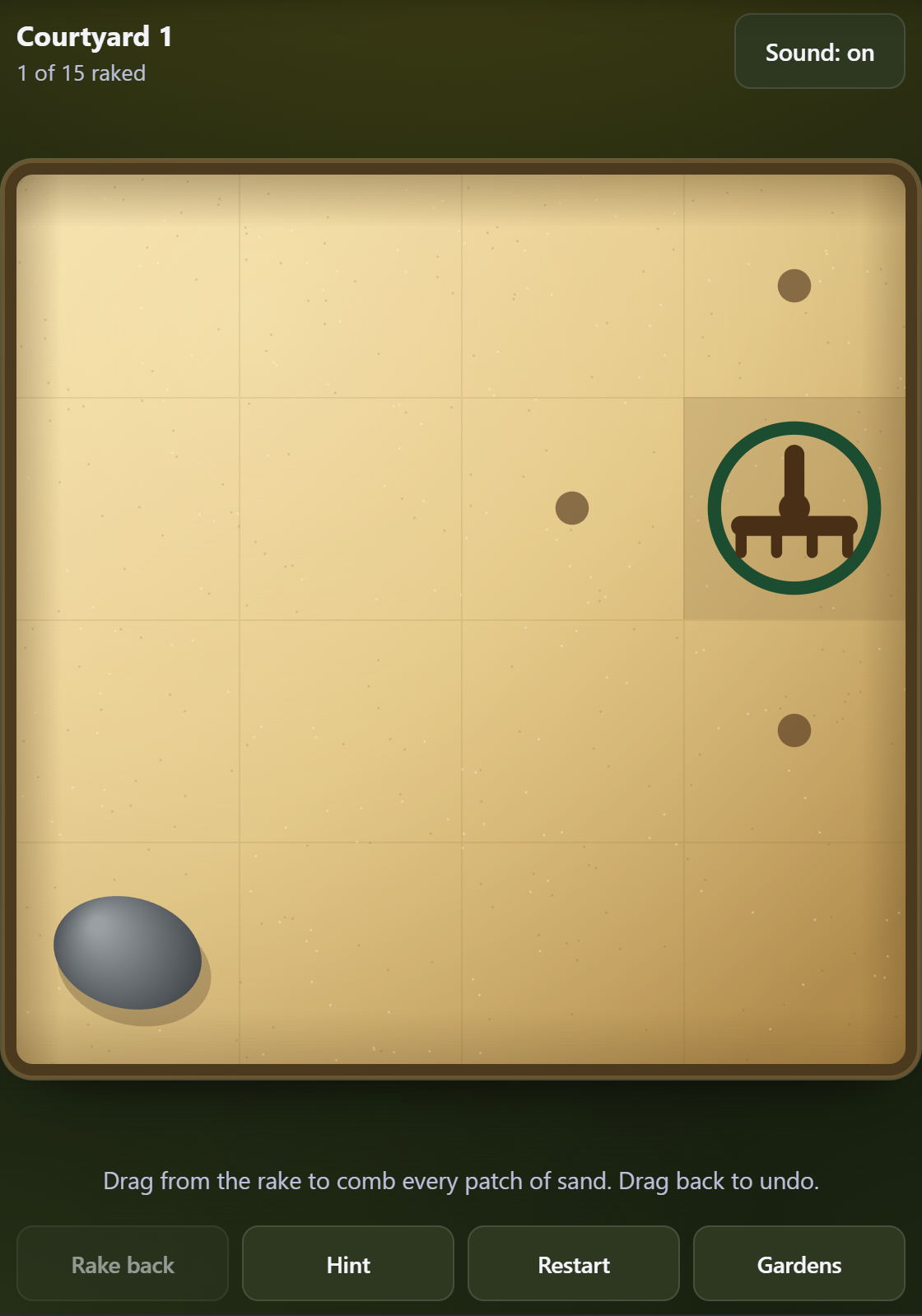
For each awkward-looking patch, count its open neighbours. A patch in the middle may offer four directions; one near a corner or stone may have only two. A location with fewer ways in and out deserves attention early because there are fewer ways to repair a bad approach later.
Look for a specific restriction, such as a pocket you can only reach through one patch. Plan when to visit it before committing to the rest of the route.
Avoid sealing off a pocket of sand
Imagine the unvisited sand as the space your remaining path must fit inside. If your route divides that space into two disconnected pockets and neither can be reached from the current end through the other, you cannot finish both. The rake does not jump across its old path.
This is why an attractive sweep across the middle can be troublesome. It may rake many patches efficiently while creating a barrier between the ones left behind. Before making such a sweep, look at both sides. Where will you enter the remaining area? Where will you leave it?
Narrow connections deserve the same care. If two larger areas communicate through one usable patch, that patch acts like a doorway. Passing through it can be the right move, but you need a plan for which side is completed first. You should not expect to cross the same doorway again later.
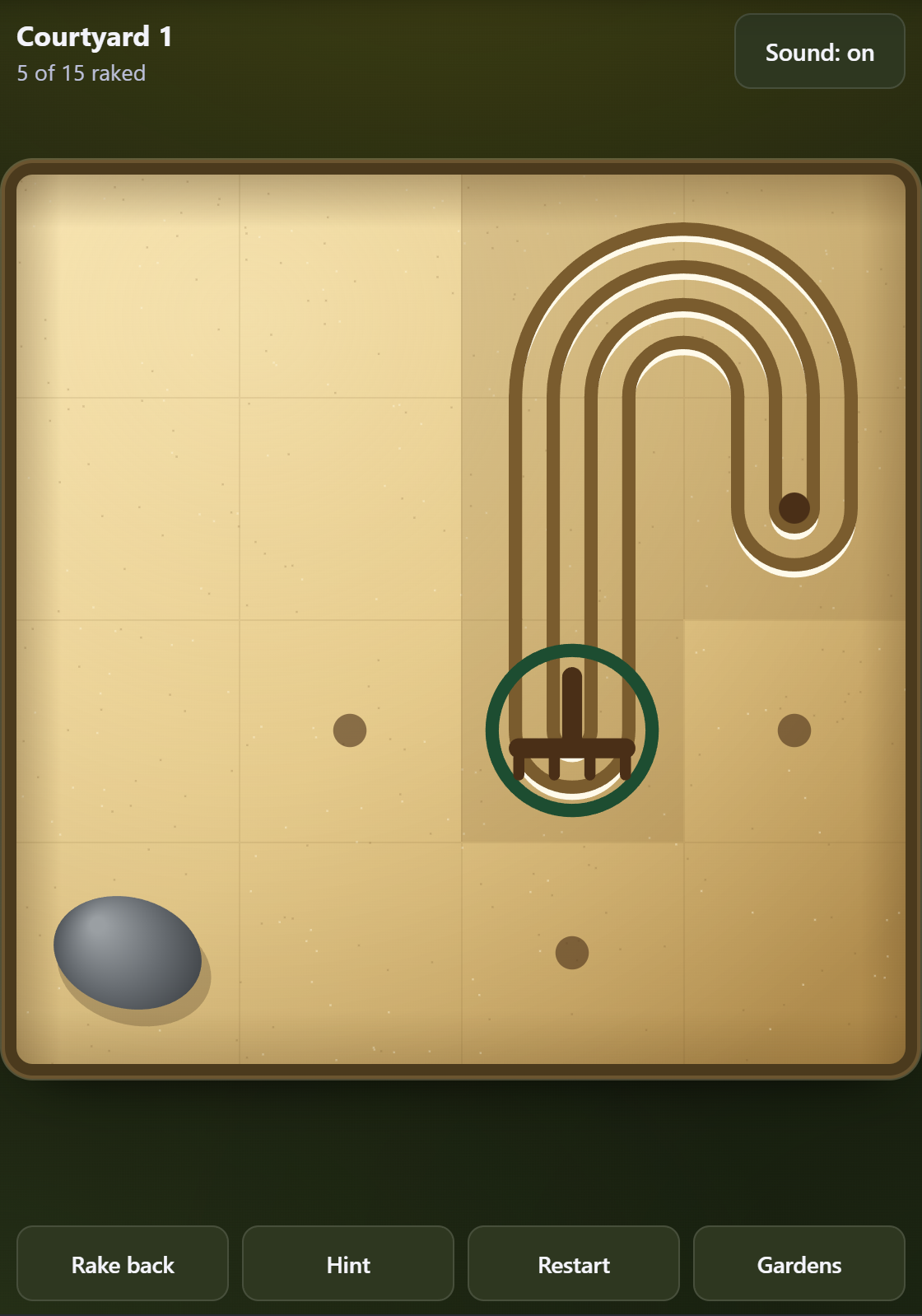
In the screenshot above, the counter reads 5 of 15 raked. Check how the ten remaining patches connect to the end of the rake’s path.
Think about endpoints when you see a dead end
A normal middle patch of the completed route needs a way in and a way out. The two endpoints do not: one is the start, and the other is the finish. That gives you a helpful way to reason about dead ends.
Suppose an unvisited patch has only one usable connection left. If you enter it, you cannot leave without revisiting the patch you came from. It therefore needs to be the final patch, unless your earlier assumptions are already wrong. Two separate remaining dead ends can be a warning when only one finish is available.
On a lantern garden, the finish is already assigned. A different isolated dead end is especially suspicious. Work backwards a few steps from the lantern: which patch must lead into it, and can that predecessor still be reached late in the route? You may discover an ending corridor that should remain untouched until the rest is done.
Following the edge can strand patches in the middle. Check where the remaining sand connects before continuing around the outside.
Undo just enough to learn what went wrong
When the route stalls, do not automatically restart the whole garden. Rake back until you reach the decision that caused the problem. Ask whether you left a pocket behind, entered an ending too early, or consumed the only connection between two areas.
Then change that decision and keep the part of the route that still makes sense. This makes each attempt informative. Repeating the same opening with a different final wiggle is unlikely to help if the mistake happened near the start.
You can also use Hint. The hint examines the current path. If a completion remains possible, it shows a short continuation. If the current route cannot finish, it points you back toward a recoverable position. A hint is most useful when you study the relationship it exposes rather than merely copying the next marks.
During our check of Courtyard 1, we raked back one patch and then completed the garden. The game recorded the rake-back, and we could finish without restarting.
Keep the quiet pace without promising an easy puzzle
You can pause over a difficult corner for as long as you need. Later gardens still take some thought, particularly when a lantern fixes the ending.
Try a larger garden when you want more planning, or replay an early one to aim for a clean rake.
On your next board, find the patch with the fewest ways in and out. Work from that restriction until you have a reason for your first turn.
If you enjoy working through constraints, Lantern Nonogram gives you row and column clues to solve next.
Checked against Pebble Furrow v1 on 23 September 2026, including an ordinary-input Courtyard 1 completion and a rake-back. The screenshots preserve the actual game state. This guide offers planning methods, not a single prescribed solution for every garden.